
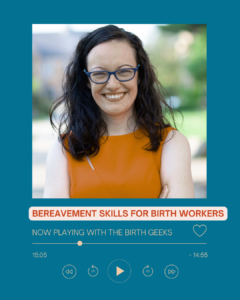
Episode Summary
Dr. Abby Jorgensen has been thinking about loss since long before she was a doula. She came to Robin’s birth doula training as a sociology PhD student who had spent years sitting with families through miscarriage, and she came to birth work not to escape loss but to better understand the full arc of it. She is now director of Haven Bereavement Doulas and one of the clearest voices in the birth world on what it actually means to be prepared for grief. We have been trying to get our schedules to sync for a long time, and this conversation was worth the wait.
One in four pregnancies ends in loss. That number alone settles whether bereavement skills belong in every doula’s toolkit. Abby walks through the language that quietly undermines grieving families (the word “refund” has no place near a loss conversation), what it means to be grief informed rather than just trauma informed, and how to show up when you have fifteen minutes to prepare and a family who needs you now. She is direct about what doulas are actually hired for, which is not a live baby but support through whatever happens. Birth is birth regardless of outcome. Postpartum is postpartum. The skills you already have are the ones you need.
The conversation also goes to territory most bereavement training skips: the spiritual and existential questions that surface after a child dies, and why doulas should not run from them. Abby trained in chaplaincy literature specifically because the existing doula resources were not meeting that need, and she shares practical ways to hold space for faith questions when your own beliefs are entirely different from your client’s. Write in at moxie@thebirthgeeks.com and tell us what you are taking into your practice.
Listen to This Episode
Episode Time Stamps
0:00 Introduction and Abby’s path into doula work and bereavement
4:07 The right time to get bereavement training (now)
6:04 How generational shifts changed expectations around loss
10:00 Being the person people tell their miscarriage stories to
11:58 Why “refund” is the wrong word after a pregnancy loss
16:14 What “grief informed” means and why it matters
17:01 Separating grief from trauma in birth and loss support
19:40 What to do when you get the call and you are not prepared
22:31 Haven Bereavement Doulas: courses for every level of readiness
27:49 Supporting spiritual and faith questions across all beliefs
37:05 Building listening and curiosity skills in everyday life
40:15 Learning from social media and specialized resources
Key Takeaways
1. Bereavement training is not optional for anyone in birth work. One in four pregnancies ends in loss. If you attend births or postpartum clients long enough, you will encounter it. The only real question is whether you will be prepared when it arrives.
2. Drop the word “refund” from your vocabulary completely. Telling a client you will refund them if the baby does not survive carries an implicit assumption that they hired you to guarantee a live child. They did not. A family experiencing loss does not need money back. They need support, which is what you are there to provide.
3. Being grief informed is a distinct and necessary skill set. Trauma informed practice is essential, but grief and trauma are not the same thing. Grief can exist without trauma. A birth can be devastating and beautiful at the same time. Doulas who can hold that complexity without collapsing the two together serve their clients far better.
4. Your existing doula skills are the right foundation for loss support. Birth is birth regardless of outcome. Postpartum is postpartum. If you get a call you are not fully prepared for, start by listening well. That is what you already know how to do, and it is exactly what the family needs.
5. You do not need to share a client’s spiritual beliefs to hold space for their questions. After a child dies, the big existential questions surface. Doulas who are willing to enter those conversations, ask about what matters most to the person in front of them, and sit with uncertainty without having to supply answers are doing something essential.
6. Practice bereavement support skills in low-stakes everyday moments. Toddler meltdowns, cranky neighbors, teenagers — everyday moments when someone is in distress are real opportunities to practice listening, entering someone’s emotional space, and resisting the urge to fix or explain.
7. Not every doula needs to specialize in bereavement, but every doula needs bereavement skills. Haven offers a quick-access audio course for doulas in an urgent situation, a one-hour foundational course, and a full 12-hour training for those going deeper. Every birth worker needs something. The level is up to you.
Mentioned in This Episode
Haven Bereavement Doulas, directed by Dr. Abby Jorgensen
Caring for Clients Through Loss, quick-access audio course from Haven for doulas who need information urgently (available at Access Caring for Clients Through Loss)
Basics for Bereavement Support, a one-hour Haven course for applying existing doula skills in loss situations
(Scroll down)Haven’s 12-hour Bereavement Doulas training for deeper specialization
Abby’s post on the word “refund” and doula policy after loss
TaKiesha Smith, CBS, CLC, CD(DONA), lactation after loss specialist (course available at bereavementdoulas.com)
The Milk Bank, resources for lactation after loss
Institute for the Study of Birth, Breath, and Death, resources on spiritual perspectives in bereavement support
Read the Full Transcript
This transcript was auto generated from the recording. Speaker labels are not included. There may be small transcription errors.
0:03
Hey, Hillary. Hi, Robin. And I'm really excited today because we are going to talk to one of my favorite people, Dr. Abby Jorgensen. Welcome to the Birth Geeks podcast, Abby. Thank you. I'm so excited to be here with both of you. We've been trying to get our schedules to sync for a long time because we've wanted to have you on here. And I go way back with Abby. Abby was also one of my students many, many years ago. And I still remember where you sat. I still remember all the things, like, you're very attentive, but you came in to my class in a very different space than a lot of people came to birth doula training. Do you want to tell me a little bit or. I mean, I know, but do you want to tell everyone else a little bit about how you wound up in my class doing that training? Absolutely.

That was a long time ago. It was six or seven years. And at that point I was in graduate school. I was studying sociology, especially Sociology of the Family. I was really interested what happens when people want to have children and try to have children. And I was really interested in what happens when people experience loss. I was also working at the same time with families in my community as what was known as like, the shorthand for me was the miscarriage nanny, where I would come and sit with your kids while you were having a miscarriage, or I would come and be with you at an appointment if you needed somebody to drive you or you just wanted company. And I got the opportunity then to look more into what happens when birth actually goes well, what happens when things end in a live, happy, healthy baby, and realized that maybe that was going to make the work that I was doing with lost families and the research I was doing about loss a little more sustainable long term, to remember that sometimes things work out beautifully.

And obviously, in a birth doula training, you talk about a lot of terrible situations and a lot of situations where there isn't that happy experience. However, that looks. Robin, I remember you talking about bereavement during our training, but at the same time, it opened up a world to me. Like, sometimes these stories are happy in addition to beautiful. So I was really used to birth being beautiful. I was really used to sorrow and joy going hand in hand. I was really used to loss. But then I ended up taking Robin's training as a way to try to expand a little bit more into later births and into births when sometimes the baby makes it.

So I very much came from a totally different perspective. Everyone else in the room was like, oh, at my birth, this thing happened. And so now I'm a doula because of that. And I was sitting there as someone with no living children at the time who just wanted to learn more about how to support other people through birth. And I'm so glad that I found Robin's training and took it and then met Hillary through that as well.

I think you hit the nail on the head because I think what really stood out to me and what I think about when I look at people who come to training is that most people are like, right, we're gonna go home with a baby. Like, that's the ultimate prize. Like, that you can always say, at least you have a healthy baby. Right? Like, and there are so many things wrong with that statement. We dissect that so many different ways. But it's often eye opening to people that sometimes things don't go well or that people don't have a living child or a healthy baby or a healthy parent. And that is, I would say, probably the vast majority of people come in, like, thinking about that. And then occasionally I will get someone who I can barely get my name out at the training, and they're like, what happens if the baby dies? And then everybody else goes, oh, like, can that happen?

And that's a really hard place to start, like a birth doula training at. But obviously it is something that we have to talk about, whether you're a birth doula, postpartum doula, right, childbirth educator, midwife. Like, everybody is going to have to deal with this at some point.

4:07
Now I would ask you, is there a right time, a best time for doulas, childbirth educators, etc. to know about loss or think about loss, or when do you see them sort of enter into the picture?

I think the best time is the minute that you're listening to this podcast. Like, the best time is right now. So if you have not gotten any training in bereavement support, it is time. Unfortunately, if you work in the birth world until you support a family through loss, we know that one in four pregnancies approximately ends in loss. And that means that if you're the kind of doula who gets hired as someone is peeing on a stick, or if you're the kind of doula who gets hired at 20 weeks gestation, or if you're the kind of doula who gets hired the day before the baby comes, like, whatever stage you are in supporting a family, you're going to have that experience of supporting a family through loss. It is just a matter of when, not a matter of if.

And so the best time is right now. The better time is at your training. Which is why I value Robin's inclusion of bereavement support in the actual training so much. And I think that live birth or expected live birth doula trainers who don't include that are doing a real disservice to their trainees. But even postpartum doulas, even fertility doulas, even adoption doulas, surrogacy doulas, like all these different kinds of doulas, are going to interact with loss of some kind and probably perinatal loss specifically at some point in our careers. And so the best time to do it is right now. And for some people that means picking up one book or taking a one hour training. And for other people that means really delving into it. I don't think all doulas need to be bereavement doulas, which is what I primarily call myself and primarily identify as. But I do think all doulas need bereavement support skills and the best time to get those is right now.

6:04
I love that. I've never heard you call yourself, by the way, the miscarriage nanny. Yes, I got rid of that a long time ago. So can you give us a little historical perspective with regards to bereavement? I know that maternal mortality, infant mortality has improved so much through history. And when I talk to older parents, like my grandparents' age, they have a much different perspective with regards to expectations. Have you seen that? And then second, does everyone tell you their miscarriage story? Because as a birth doula, everyone tells you their birth story.

I like these questions. So in terms of the history and how things have changed around loss, it used to be that you were really lucky if half of your children survived till adulthood, from birth to adulthood. And now things like child mortality are so much lower and not as low as they should be and not as low as they could be, but a lot lower. We have much better chances of babies surviving infancy and childhood thanks to so many different advancements in science. But we also have this sense, I think, and maybe especially have, with the rise of things like artificial reproductive technology, that we can control everything now, that we have fixed all the problems. And that is just so far from true.

So with this growth in societal recognition of the power, the influence that we have over these processes of biology, of conception, of pregnancy, of birth, of infancy, I think that might make people think those were the old days. Like, kids died back in the old days. That doesn't happen. And they don't realize that that's actually a really specific viewpoint to have that's not very widely shared. There's this wide range. I've had every conversation from someone telling me what you do is pointless, because in my generation we just tough it up. And then I've had other older folks who are like, if I had access to half the resources that you all have access to now in your childbearing years, think of how much more support I would have had.

To be really clear, there is this recognition that things have gotten a lot better. It's gotten a lot easier to keep little ones alive. But that does not mean that we're good at it. We've also gotten better at identifying death. We've gotten better at identifying that you're pregnant earlier. And so we know that you had a loss when maybe a few generations ago, we wouldn't have known that that was a loss. So I think there's a wide variety of ways that things have changed a lot over even just the last couple of generations.

10:00
About does everyone tell you their miscarriage story? Yes. And I have worked really hard on curating my response to that because sometimes my initial response is one of irritation, like, we are at a work party for my husband's job, like, I'm not ready to receive this trauma right now. But I think there's something about being a bereavement doula, kind of like chaplains I talk to or priests and ministers I talk to, where once somebody knows that you're a safe person, there's often just this need to immediately share. And I think that happens with expected live birth doulas a lot too.

When it's a bereavement situation, it kind of means that you're always on call for having that conversation. You're not always on call necessarily for supporting a family through a birth or planning a funeral or taking out somebody's car seat from their car at the hospital, but you are all of a sudden on call for being open to other people's grief. And that's something that I think our whole society could do way better at. Like, yes, everybody tells me their miscarriage story, and that's an honor because it means that I've shown them that I can be a person who's trustworthy with that. But it's also exhausting. It's really hard. Just like it is when you say you're a birth doula or a postpartum doula and they're like, let me tell you my eight stories about cracked nipples.

11:58
So one of the things, Abby, that I think you do really well, in things like Doulas Doing Business, like when you've talked about how to incorporate this into your everyday doula practice, is there are some really technical questions that people ask. And one of the questions that I get all the time, you wrote a whole blog post about this, is do you refund somebody? And why you don't use that terminology. What are some of the terms that you wish would go away or what do you hope people would say more of?

Yes, oh I love this. One of the things that came up a lot, both in my practice as a doula and in my research, is the word refund. And I think the word refund should be abolished from every doula's vocabulary when it comes to loss. I think there's this really natural impulse for many of us to try to fix loss when it happens, to try to solve the problem, to try to make things better, which is just not a thing we get to do. And one way that we often try to enact that beautiful desire to help is by saying, I'm going to refund the client their money if the baby doesn't survive. But this has so many assumptions built into it that I don't think doulas know or recognize when they say it.

What a refund is: I buy some outfit from an online store, it shows up and I try it on and I don't like it or it doesn't fit. So then I package it up and send it back, and the online store puts all the money back into my account and everything goes back to the way it was. And that story does not describe the experience of a lost family. It has this assumption that what you're paying a doula for is a live baby at the end. And that's not true.

When we tell clients, I'll refund you if your baby dies, what we're saying is you're paying me to assure a live child, and unfortunately, that's just not within our power. That means that people are in a situation where, if they have a loss, why would they call their doula? Like, the doula is now an unnecessary point, because doulas are there for happy live babies. And I just, that's so far from the truth. I really wish that in society, people who have hired a doula who experience a loss, their first thought after getting any emergency medical care they need is, I gotta call my doula now. Because I need support more now. And that's what we, as doulas do. A family who experiences a loss doesn't need a refund. They need support. And that's what we should show up and provide.

There are other terms I don't like. I don't use miscarry as a verb because it sounds like you're implying that the person has carried the child incorrectly and therefore has had a loss. I say experienced a miscarriage instead.

16:14
A term I'd love to see people talking about more is being grief informed. We talk about being trauma informed a lot in the doula world. But it's also important to do that with grief. What does it mean to be able to talk about miscarriage, stillbirth or infant loss on your Instagram account? What does it mean to be ready with a plan for supporting a client when they call you and say they just checked and there's no heartbeat? Like, that's being grief informed. And so that's one term I'd love to see more of.

17:01
Yeah. I think one of the things that I find myself saying in doula training is that you've got grief and you've got trauma. And we could do this without the trauma and just the grief. And I've been to many a birth where a baby is born sleeping, where it was a beautiful birth and the parents felt well supported and well cared for and were so sad that their baby died, but everyone wrapped them in their arms and held them really close and they felt the support of that community and that it was still a beautiful birth. And people are just really surprised that you can put those two words together.

Yeah, absolutely. And that for bereavement could be true before the birth of the little one. The family might know even months in advance. I once got to work with a family for seven months before their child died. And we knew that their child was going to die. So you might have time beforehand, before the birth, you might be supporting the family at the birth, or you might find out after the birth. And in all those situations, the family will need support at whatever time you heard about it.

So being able to go from the traumatic story of grief to just the story of grief, or maybe even the supported story of grief, is so beautiful. Some people are shocked to hear that I've been to bereavement births where there's more laughter than some live births I've been to. And that should not surprise people. Like, grief can encompass joy and sorrow and relief and excitement and eagerness to meet the child and thrill to introduce the child to their siblings, all at the same time that the baby is dead. And so holding all of those things together, making space for somebody to show up and say, this is hard and this is beautiful and this is sad, and I'm here for all of it. That's the gift that doulas can bring to bereavement situations.

19:40
So let me paint a scenario for you. You've got a doula, they're well trained, they're out there attending births, and they get that call that there wasn't a heartbeat found and they're going to the hospital to be induced. And the doula gets in the car and starts driving there, but has no clue what they're doing. What's your best advice for someone in that situation other than don't get in that situation?

Yes. That is the first lesson. If you're listening to this, do not let that be you. But all right, well, you're listening to this, so you're already not letting that be you. I was that person. I was not that person as a doula, but I was that person as a friend. And I have a lot of sympathy for this person in this scenario because that has been me before.

I think one of the first things to do is get what information and training you can in the time that you have. So if you have 15 minutes, that's enough time for a blog post to understand a little bit more about what you're walking into. So read a blog post about how to listen well. That's what you've got in your 15 minutes. But you might just be walking in to support this family and using all of your skills that you have as a doula that you already practice, whether that's birth, postpartum, fertility, etc. Those are going to be really important, especially the listening.

The other thing is remember that birth is birth. So if this is a birth situation, birth is birth, regardless of outcome. We see that all the time. Birth is birth. It does not matter if the little one is alive or dead. Birth is birth. So if you have skills to support a birth, you have the skills you need to support this family. If you are a postpartum doula, postpartum is postpartum. Families are still dealing with hormones, still dealing with work problems, still dealing with so much, even though the baby isn't there. So postpartum is postpartum. Birth is birth. You have the skills you need to do this. It might look a little different, but please show up anyway.

22:31
Now I know that you are the director of Haven Bereavement Doulas, and you have this whole training for people who want this to be their primary focus. But you also have other courses. Can you tell me a little bit about who those are for in case some of our people see themselves in need of that?

Yeah, absolutely. So if you're in that scenario where you just found out that a client might be having a loss, and you need very quick access to information that's already ready for you, then the Haven Bereavement Doulas course, Caring for Clients through Loss, is the course that's designed specifically for you. This course came about because I kept having doulas I did not know texting my phone in the middle of the night with questions about how to support people through loss. And it was the same questions over and over. What do I wear to this birth? Really common question. What should I say or not say?

You're surprised by the what to wear, Hillary? I am surprised. I don't know what to wear. Like, what do you wear? Well, I think a lot of people have like welcome baby shirts or something like that. And my brain went, do I just need to wear all black? With some of my clients, they come from cultural backgrounds where red, the color of blood, is really offensive to wear at a death. I won't wear red anymore on my way to birth, just in case this comes up. So there are real questions about what to wear to a loss that people don't necessarily think of.

So Caring for Clients through Loss came about so that doulas who really wanted to do well by their clients but didn't know how in this situation could go find the one part of this course that they needed right that minute and listen to it. And it's all available in audio format. So if you're driving to the hospital, you can still listen safely.

Then we have Basics for Bereavement Support, a one-hour course for folks who are already practicing as doulas who want to know how to take their existing doula skills and shift them just a little bit in situations of bereavement support. Or we have our whole 12-hour Haven Bereavement Doulas training. But again, not every doula needs to be a bereavement doula. Every doula does need bereavement skills. So however you find those, let me know. It's a beautiful gift to give your future self. Don't text Abby at 3:00 am.

27:49
One of the things that I appreciate about your training is that you bring in faith for everyone, wherever you fall, whatever faith you have or don't have. And I appreciate that because I have clients from all different walks of life who have all different sorts of beliefs. Do you mind talking a little bit about the faith aspect of this work?

This is something that I was so frustrated to find so few resources about when I really started looking, about eight years ago. The idea that doulas attend to or are there for spiritual support was not something that I found holistic responses to. A lot of the stuff I found was like, hey, evangelical Christians, here's how you help evangelical Christians through their miscarriage. Or, hey, Muslims, here's how you help Muslims through their stillbirth. And I really wanted something that was going to help me provide spiritual support for lots of different folks.

Because death is a thing that brings up big questions. After the death of a child, if you're not asking questions about God, fate, karma, justice, the universe, you name it, you're missing some piece of the reality that's happening. That is such a natural human instinct to start wondering, to start questioning, to start trying to make sense of the loss that has occurred when this isn't how it's supposed to be. Children are supposed to bury their parents, not the other way around. And so having this opportunity to dig into, as the doula, I'm in a really safe role for this family. They have picked me and entrusted me with some of the most vulnerable details of this experience. Of course God, fate, karma, justice, the universe are going to come up. Am I ready for that?

And what's really funny is I was not. I still may not be fully ready for it, but I'm ready for the conversation at least now. Even I'm Catholic, I'm pretty Catholic. And even when I support Catholics, there are things that are going to come up where our spiritualities might be a little bit different. So the idea of having resources for people who want to support everybody and want to be open about faith was really important to me. A lot of the bereavement doula stuff that was out there wasn't talking about religion or faith or spirituality or philosophy at all. And I think that's a huge disservice to our clients. And I really wanted something to help me feel prepared. So a lot of the material that I ended up working with and reading and now cite all the time is from chaplaincy work, where people are working with folks from all different walks of faith or non-faith and are trying to talk about the realities because that's what we're there for is support. And sometimes those kinds of support might be spiritual in nature.

What are some of the challenges that come up for people asking themselves how to help somebody who is of a different faith or philosophy than mine?

Yeah, I love that. I think the first thing that comes up is fear that we shouldn't be having the conversation to begin with. Like, death and religion, you're not supposed to talk about those. You're also not supposed to talk about the death of children in particular. So there's a lot of social stigma around having the conversation. Sometimes it's a fear of entering the conversation, and sometimes it's a fear of not knowing the answer to the question the person's asking. But even when I know the answer, that's probably not my role to say it. Like, I get to hold space for the question as the doula. That's what I get to do.

So one of the techniques that I often use when somebody is a really different spirituality than mine is I'll listen for the words that carry the most meaning for them. If they're repeating a word, that's a pretty good clue that that word is really important. And I'll just ask. I'll say, like, you mentioned this saint, and I don't know who that saint is, but they seem really important to you. Can you tell me more about that? Or like, you mentioned reincarnation, I don't know much about that. Can you tell me more about that? And just inviting the conversation more, showing that I'm a person who, even if I'm ignorant, I'm very eager to listen. I don't need the answer. I do need the courage to overcome the fear of not having the answer. Being able to ask questions and say, I hear you saying why a lot. Can you tell me more about that? Those are really good ways to open the door for that conversation.

37:05
Abby, first of all, as a fellow social scientist, I hear so much of your qualitative skills coming through, and I'm loving it. The work that you're doing is massively contributing to the sociology of death and dying. You're doing really important work, so keep it up.

How do you see doulas using these same kinds of skills in our work? These really important holding space, listening, asking good questions, reserving judgment. How do we cultivate those skills a little bit further, especially with regards to bereavement?

Yeah. One piece of it is learning more skills. And if none of these skills that we've mentioned have been surprises to you, you might have to do some digging to go find some new skills, new ideas. How do I learn to listen better? What books does your library have about different care and support skills? What books can you find about burnout for chaplains? That's probably applicable to you. Ask a doula buddy or backup, give me a challenge, like give me an experiment to try to practice. And then my suggestion would be to practice it in a neutral or much less stressful setting.

So I often use this example of my beloved daughter. We would start every morning with, I would toast a bagel, put cream cheese on it, give her half, I'd eat half myself. And that was how we started our day. And this was when she was 3, and every day for at least 10 months, this was our ritual. And then one day when I handed her her half of our toasted cream cheese bagel, she started completely having a meltdown. Lost her mind because I had toasted the bagel. For like possibly hundreds of days in a row, I had been toasting the bagel. Like, I could not understand why she was having the emotional reaction she was having.

But what an amazing opportunity for me to practice bereavement support skills. Like, this is a loss to her. Nothing near the loss of a child. What a great low-stakes place to practice. Like, what an amazing opportunity my toddler has presented me to become a better doula, to think through, okay, let me try this strategy, let me try this response. Let me notice the irritation in myself. That little snarky voice that pops up even though I don't want it, it's still there. How am I going to handle that?

And so taking the opportunities that your toddlers or your teenagers or your angry, cranky neighbors present you to practice entering into people's emotional spaces, whatever those could be. There are so many opportunities life gives us to practice that.

40:15
I think social media obviously is a double-edged sword for so many reasons. But one of the things that I really appreciated is learning through the stories that people share on social media. Are there other people online that you have appreciated the things that they've shared that can help doulas learn in that a different low-stakes way as well?

Yeah. The names that come to mind are bereavement doulas and birth workers more so than parents. I think learning from parents' stories is so important and beautiful. But there are lots of different aspects of loss that can be hard. So finding the one that you're realizing your clients need more might be really helpful. So if you have a lot of clients who are experiencing difficulties with lactation after loss, follow Takisha Smith. She's got all of the lactation after loss. She has a course on Haven's website about lactation after loss. The Milk Bank is another great account to follow for help with lactation after loss. I think a lot of doulas even don't recognize that families can be lactating as early as 12 weeks gestation. And so someone could have a miscarriage and all of a sudden be lactating and not have the resources or support that they need.

If you're interested in learning more about different spiritual perspectives, the Institute for the Study of Birth, Breath, and Death. I love the stuff that they do. They were some of the most helpful folks in me getting started as a bereavement doula. They don't have a bereavement doula training itself, which is part of why Haven came to be, but their resources on learning about different spiritual perspectives are so helpful. So, to figure out what you need, figure out what skill you want to shore up, and then look for folks who are doing that already and see what you can learn from them.

Abby, where can we find you on the interwebs? At Abby the Sociologist Doula. I also am the director of Haven, which is at bereavementdoulas.com. When you're not teaching or hanging out with your kids. Reading a million books, right? Books are a big part of my life. My kids are a big part of my life. And then hopefully hanging out with my doula friends is a bigger part of my life now that summer is here and the semester is over.

Yay. Abby, thanks for coming today. We've been meaning to have you on for a while, and it's been a great conversation like I knew it would be. Yeah. Thank you so much for having me and thank you for the beautiful and impressive questions. Thanks.