
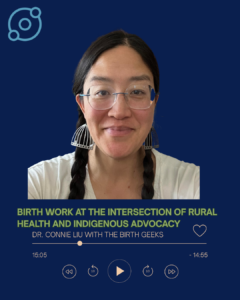
Episode Summary
Dr. Connie Liu trained in Boston, worked at Boston Medical Center and Mass General, and then moved to Gallup, New Mexico, where she has spent the last eight years practicing OB/GYN at the largest hospital in the Indian Health Service system. She has no plans to leave. In this conversation with Hillary, Connie walks us through what rural obstetric care actually looks like at Gallup Indian Medical Center, why the IHS exists as a legal obligation rather than a moral one, and what changes when the midwives run the floor and the OBs consult.
The numbers tell part of the story. Roughly half of Connie’s obstetric patients have some form of diabetes in pregnancy and a quarter have hypertensive disease. The primary cesarean rate has held around ten percent. The other part of the story is the close-knit collaborative practice that produces those outcomes, the surgical scope rural OBs carry that urban specialists hand off, and the patients who become neighbors at the grocery store. Connie also explains the difference between federally run IHS hospitals and 638 tribally run facilities, why the Cherokee Nation opening its own medical school in Oklahoma matters for the workforce pipeline, and what it feels like to come into a predominantly Navajo community as an outsider.
The conversation gets sharper when we get to the policy layer. Connie describes how a single federal purchasing rule, the PADER process, gutted overnight ultrasound coverage, cut labor and delivery beds in half, and forced patients onto two-hour drives for inductions. She points us to Dr. Katy Kozhimannil’s research on the accelerating closures of rural obstetric units, the widening urban-rural mortality gap among working-age people, and the disproportionate impact on Native and Black pregnant patients. She talks about practicing OB in a post-Dobbs landscape inside a federal facility constrained by the Hyde Amendment, and what gets lost when people conflate elective abortion with all loss care. Connie’s two birth stories, including one with a midwife friend on the phone while she labored at home in a borrowed tub during COVID, round out the episode.
Listen to This Episode
Episode Time Stamps
00:20 Reconnecting and the Cleveland ACT UP days
02:24 From Boston Medical Center to Mass General to New Mexico
04:08 What rural OB practice looks like at Gallup Indian Medical Center
07:15 What the Indian Health Service is and who it exists for
08:22 Federally run hospitals versus 638 tribally run facilities
10:38 The Cherokee Nation medical school and the tribal workforce pipeline
11:43 Coming in as an outsider to a predominantly Navajo community
12:52 Why people choose rural medicine, and what training exposure does
14:42 What rural actually means in driving distance
16:50 Midwives running the floor, OBs as consultants
17:41 A primary cesarean rate around 10 percent
19:32 Community advocacy and Rehoboth McKinley Christian Hospital
21:19 How national decisions trickle down to small hospitals
22:23 The PADER process and what it broke
24:14 Rising rates of diabetes and hypertension in pregnancy
24:44 The widening urban-rural mortality gap
26:13 Disparities for Native and Black pregnant patients in rural areas
27:30 Dr. Katy Kozhimannil’s research on rural OB closures
28:15 Practicing OB after Dobbs in a federal facility
29:08 Elective abortion versus medically indicated care, and what the language obscures
30:31 What polling actually shows about New Mexicans on reproductive choice
33:00 Connie’s two very different birth experiences
34:42 Checking her own cervix in the birth tub during COVID
37:08 The Navajo Breastfeeding Coalition and community doula work
37:43 Closing question
Key Takeaways
1. Midwife-led care with OB consult produced a primary cesarean rate around 10 percent. That number holds in a population where half of obstetric patients have diabetes in pregnancy and a quarter have hypertensive disease. The model is not a fluke, it is the result of a collaborative scope where midwives run labor and physicians step in for complexity.
2. The Indian Health Service is a legal obligation, not a moral one. Connie frames this carefully. IHS exists because tribal nations negotiated for it as part of treaty obligations. Reframing it as a treaty matter rather than a charity matter changes what advocacy sounds like.
3. About half of hospitals serving tribal communities are 638 tribally run facilities. The other half are federally run IHS hospitals. The Cherokee Nation opened its own medical school in Oklahoma in the last two years, and that workforce pipeline matters for the long arc of tribal sovereignty in care.
4. A single federal purchasing rule can dismantle a small hospital’s labor and delivery service overnight. Connie describes the PADER process putting pre-approved staffing contracts and surgical equipment replacements on hold. Beds cut in half. Inductions sent two hours away. Families separated when they should have been together.
5. The urban-rural mortality gap among working-age adults is widening, and rural pregnant patients are driving the trend. Connie points to USDA analysis of CDC mortality data and to Dr. Katy Kozhimannil’s research. Native and Black communities in rural areas carry the disproportionate burden. More than half of rural hospitals no longer offer obstetric care.
6. The Hyde Amendment, not Dobbs, is the more immediate constraint inside federal facilities. Connie cannot provide elective abortion at her hospital because of the Hyde Amendment, regardless of New Mexico’s state-level protections. The medically indicated care that gets coded as abortion in the record, however, is still part of her practice, and the public confuses the two constantly.
7. How you ask the question changes what the answer looks like. Stronger Families’ New Mexico polling found that people split on political lines when asked whether they support abortion, but converge across party when asked whether people are capable of making their own healthcare decisions. The framing is the fight.
Mentioned in This Episode
Episode 66: Navigating Birth, Burnout, and Being Queer in Midwifery with Katie Shannon
Gallup Indian Medical Center
Boston Medical Center
Massachusetts General Hospital
Cambridge Health Alliance
Tsehootsooi Medical Center, Fort Defiance Indian Hospital
Rehoboth McKinley Christian Hospital
McKinley Regional Health Advocacy Committee
Physicians for Reproductive Health
Dr. Katy Kozhimannil’s research on rural obstetric care and hospital closures, University of Minnesota
USDA Economic Research Service report on rural mortality
The Hyde Amendment
Cherokee Nation College of Medicine, Oklahoma State University
Navajo Breastfeeding Coalition
Read the Full Transcript
This transcript is auto-generated and lightly cleaned. It may contain errors, misheard words, or formatting quirks. We have left the speakers labeled as recorded.
DR. HILLARY MELCHIORS (0:20): Hello, Connie.

DR. CONNIE LIU: Hey, Hillary. How are you?

DR. HILLARY MELCHIORS: I am so excited to get to talk to you. I was actually just thinking, I think the last time I saw you in person, I was like 10 days postpartum.

DR. CONNIE LIU (0:35): Wow.

DR. HILLARY MELCHIORS: Do you remember? It was a very long time ago. I came to a surprise party at your house.

DR. CONNIE LIU (0:57): Now that I've had a baby, I extra understand how difficult that was.

DR. HILLARY MELCHIORS (1:01): And I think that's not true because we saw each other at that specific friend's wedding as well. Katie Shannon, who I also had on the podcast, was there and I remember thinking, an OB, a doula and a midwife walked into a wedding. Like we were a joke.

DR. CONNIE LIU: It's an excellent joke.

DR. HILLARY MELCHIORS (1:30): Connie, you and I actually met in a political meeting. It was an ACT UP meeting. You were a resident at the time, both of us at Case.

DR. CONNIE LIU (2:04): I don't remember specifically the meeting, but I know that we went to several meetings like that together.

DR. HILLARY MELCHIORS: You just finished working in New Mexico. How did you end up in New Mexico? Let's talk about that journey.

DR. CONNIE LIU (2:25): So I was working in Boston at the time. I had finished my residency at Boston Medical Center, which was a great place to learn how to be an OB-GYN because I learned from a lot of people who grounded their clinical practice in justice. And it was a great place also for obstetric care because it's a very midwife-forward program for being an urban referral center. I was working at Mass General Hospital, which is another large academic urban center. And my husband and I were looking for something different. I had talked to somebody who used to work at the Indian Health Service. So we applied for the job. We've been there for eight years and have no plans on leaving.

DR. HILLARY MELCHIORS (3:48): So you went from this massive teaching urban facility to fairly rural. Is that a fair characterization?

DR. CONNIE LIU (4:03): Yeah. I went from a place where we had 25 generalists on staff. We had every specialty you can imagine. The hospital I was working for is Gallup Indian Medical Center. It's the largest hospital in the Indian Health Service system nationally. But even then it was pretty small. I knew every single physician and midwife and nurse practitioner who worked there. It just has a very different feel. Everyone universally said they really love the mission. They love taking care of the community and the patients, and they love living in the community that they're caring for. And they really like the flexibility of practice. One midwife told me she really loves it because she feels like she's practicing everything that she learned how to do as a midwife. Our midwives were taking care of some really complicated patients. It was a very collaborative relationship.

DR. HILLARY MELCHIORS (6:48): So you met someone that worked in the IHS. I really know very little about the IHS and the mission. I'm assuming there are some possible funding issues, given the current political climate.

DR. CONNIE LIU (7:09): Yeah. Let me tell you a little bit about the Indian Health Service. The IHS as a whole is basically a legal obligation of the United States to the tribal communities that live on this land. I think a lot of people think that IHS exists because of some kind of moral obligation. The United States has had a very extractive relationship with tribal communities. Tribal communities have stood their ground and said, if you are taking these things from us, then we expect something in return. So health care is one of those things. Some hospitals are federally run Indian Health Service hospitals, which is what my hospital was. But 50% of hospitals on tribal land that serve tribal communities are 638 facilities or tribal facilities. They have money that they use to run the hospitals themselves. So on Navajo Nation, for example, there is a hospital about 40 minutes east of where I am which is totally tribally run. Because they exist as a treaty obligation, the patients who go there need to be tribal members as defined by the tribe that they serve. So it really exists for the tribal community.

DR. CONNIE LIU (9:33): The hospital at Tsehootsooi, or Fort Defiance, has a stated mission that they would like to have the hospital be tribally run. Which is really great.

DR. HILLARY MELCHIORS (9:58): It would be a challenge to the long term staffing. A lot of long term planning as far as pipeline.

DR. CONNIE LIU (10:10): Yeah, absolutely. In Oklahoma, the Cherokee Nation very recently, in the last two years, opened up their own medical school, which I'm really excited about because that will be a real benefit to tribal communities nationally.

DR. HILLARY MELCHIORS (10:38): So many Americans still don't think about the fact that we still have Native American tribal populations that we very much need to be serving. And I'm so glad that those tribes have stood up for themselves and have had this required, continued advocacy to keep the IHS. Did you find it challenging coming in as an outsider into this smallish rural community?

DR. CONNIE LIU (11:43): Yeah, that was a bit of a cultural change. Not just because I was moving from a place that had a different demographic makeup. Where I live now, 50 to 75% of people, depending on where you are, are probably Navajo. It's also just really rural. In cities, it tends to be a little bit more anonymous. When I go to the grocery store, I will often run into people that I take care of. But it's really nice because when I do resistance work within the community, I'm doing it with people that I might potentially be taking care of, which feels really close knit.

DR. HILLARY MELCHIORS (12:48): Did you grow up in a small area?

DR. CONNIE LIU (12:52): I really didn't. When you look at studies that talk about why people go into rural medicine, a lot of it has to do with where you were raised. So a lot of people who grew up in rural areas will gravitate naturally towards jobs in rural areas. But any exposure anywhere along the pipeline can also really be a benefit. People who see what it's like to work in a rural area in residency or medical school will often choose that path. Now that I've seen what it's like, I love it and I don't want to leave.

DR. HILLARY MELCHIORS (16:41): Do you feel like you've learned some skills working within the IHS that you probably wouldn't have gotten elsewhere?

DR. CONNIE LIU (16:50): I think what I really have learned is how to work collaboratively with our midwives. Where I am, the midwives are really the ones who run the floor. We're less the people who are there to manage labor and to manage delivery. We go into it with the assumption that most people are going to be normal, and they largely are, but we serve as consultants for when there are questions or when we need a C-section or something more complicated happens. Very consistently over my eight years there, the primary C-section rate has been consistently around 10%.

DR. HILLARY MELCHIORS (18:04): Holy cow. That's amazing.

DR. CONNIE LIU (18:07): Our C-section rate overall I believe is somewhere between 20 and 25%. We do some risk stratification, so really high risk patients we refer elsewhere. But about half of patients we deliver have some sort of diabetes in pregnancy. About 25% of them have some sort of hypertensive disease of pregnancy. So people do come with some medical issues, and that's becoming increasingly true. But we still manage to preserve some level of normality.

DR. HILLARY MELCHIORS (19:32): Can you talk a little bit about community advocacy work?

DR. CONNIE LIU (19:36): We have a local hospital called Rehoboth McKinley Christian Hospital. It used to have a labor and delivery, but several years ago, the management was given over to a management company from Texas. The goals and priorities of this management company were very different than the local folks. The reason why the priorities between a management team and the community might differ is basically capitalism. Our healthcare system was deregulated in the 90s, and increasingly hospitals feel like they're being forced to make decisions about care that relate more to their need to address the bottom line than community care. I was working with a group of folks hosting town halls. We had a rally and a town hall meeting when their labor and delivery closed.

DR. CONNIE LIU (22:23): There's a process called the PADER process. The whole idea was that any federal entity needs to have all of its purchases approved by some sort of central decider. A lot of contracts had already been approved. We needed to replace surgical equipment. Then they all suddenly got put on hold. We suddenly received an email basically saying that we no longer had an ultrasonographer available overnight. We had to cut the number of beds in half. We had to schedule all patients who needed an induction elsewhere. We're basically going to move to a stabilize and transfer model. This is a huge problem because 40% of our patients have inductions medically indicated. Patients who wanted an elective induction had to go elsewhere.

DR. HILLARY MELCHIORS (24:14): Do you feel like we're seeing this expansion of the risk profile as well? I see a lot more people falling into the high risk for whatever reason.

DR. CONNIE LIU (24:27): 100% correct. Over the last 20 years, the rates of diabetes have increased. The rates of hypertensive disease have increased. I want to say that in each category they've doubled at least. There was a great study from the USDA last year where they took CDC mortality data and showed the inequity between mortality rates between urban and rural populations. The divide between mortality rates has really seen a huge widening, especially in people who are of working age, between their 20s and 50s. And what's really driving that is natural cause mortality. If you drill down in the rural data, that is being very much driven by an increase in mortality in pregnant people. And it's really affecting Native communities and Black communities who live in rural areas.

DR. CONNIE LIU (26:28): There's a lot of great research done by a really great researcher out of Minnesota. She looks at disparities in care related to obstetric care. More than half of rural hospitals now no longer have obstetric care. The rates of closures have really accelerated over the last decade.

DR. HILLARY MELCHIORS (27:30): Dr. Kozhimannil, I think?

DR. CONNIE LIU (27:34): Yeah, that's the research I'm talking about. Really fantastic. Does some really important work.

DR. HILLARY MELCHIORS (28:04): Has that been further complicated by practicing OB in a post-Dobbs situation here in the U.S.?

DR. CONNIE LIU (28:15): I live in a state that is sort of protected because New Mexico has made the conscious decision to protect people who are seeking abortion care. And I don't see as much of a difference because working for a federal facility, I'm not able to provide abortion services anyway because of the Hyde Amendment.

DR. HILLARY MELCHIORS (28:51): So if you had a patient who at 21 weeks has their baby pass away, are you then able to induce? Because that is also an abortion.

DR. CONNIE LIU (29:08): We need to actually be precise in our terminology because it's elective. We aren't allowed to perform elective abortions.

DR. HILLARY MELCHIORS (29:21): And where I live, even before Dobbs, elective abortion was not accessible. You had to drive at least two hours. But I have attended abortions as a doula because I've had clients whose fetus or baby has passed away.

DR. CONNIE LIU (30:31): It's fascinating because you watch people who are trying to make policy related to abortion care, and it's very clear that they don't understand the nuances about medical care. There's this organization I really love in New Mexico, Stronger Families. They did a really fascinating survey of New Mexicans about a decade ago. When you ask people specifically about abortion care, if you ask them, do you support abortion, they might fall along political lines. But if you ask them, do you believe that people have the capability of making decisions about their own healthcare, most people, Republican or Democrat, agree with that statement. So there's probably a lot more agreement on this particular topic than we really know. It's just that it's not being framed in a way that really talks about choice or about the medical or personal reality of pregnancy and abortion care.

DR. HILLARY MELCHIORS (33:00): So you had your children while you were in New Mexico.

DR. CONNIE LIU: I had one of them, yes.

DR. HILLARY MELCHIORS: So you've had two very different experiences. What was similar?

DR. CONNIE LIU (33:34): I very intentionally chose to deliver with a midwife for my first pregnancy. My intention had been to deliver at a birth center, but I risked out because I developed mild gestational hypertension. So I had a delivery at Cambridge Health Alliance, which was really lovely. The difference for the second one was I sort of had a better sense for what birth was going to be like. My goal was to stay at home as long as possible. We got an inflatable birth tub. My husband spent the entire night just refilling with hot water. It was during COVID. I was not interested in spending any time at the hospital if possible.

DR. CONNIE LIU (34:42): I was in the tub feeling pretty intense. So I checked my own cervix.

DR. HILLARY MELCHIORS (34:53): Of course you did.

DR. CONNIE LIU (34:57): I was 8 centimeters. I called the midwife, who was a friend on deck working the floor. She said, I think you should come in. I can break your water. The idea of making this any more intense was not something I could mentally handle. So I stayed at home, then 10 minutes later, broke my water on my own. Immediately was fully dilated. Then my husband rushed me to the hospital. I was at the hospital for 30 seconds before I had a baby. They took me directly to a labor and delivery room where I looked at her and said, what do I do now? She was like, hands and knees. A few pushes later, there's a baby.

DR. HILLARY MELCHIORS (36:45): I've often said one of the reasons I became a doula is because I had two really amazingly supported births. I want everyone to feel that supported.

DR. CONNIE LIU (37:08): There is a group of really awesome doulas in our community, including a collaborative of Navajo women, the Navajo Breastfeeding Coalition. They are doing really important work in providing support to people and bringing their culture and community to women who are delivering there. I hope to see more of that as time goes on.

DR. HILLARY MELCHIORS (37:43): I always end the podcast by asking a silly question. Connie, would you rather spend a very hot summer in New Mexico or a very cold winter in Cleveland?

DR. CONNIE LIU (38:00): Oh, my gosh. I would probably spend the summer in New Mexico and suffer through some pretty cold winters in Cleveland. I love Cleveland. But I'm just not made for cold weather.

DR. HILLARY MELCHIORS (39:00): Connie, it was so amazing to get to speak to you. I hope you have a wonderful vacation.

DR. CONNIE LIU (39:00): Thank you. It was really nice to see you.